•  
Maiji Mountain Grottoes Cave Buddha Statue

Maiji Mountain Grottoes Cave Buddha Statue

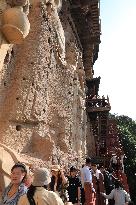
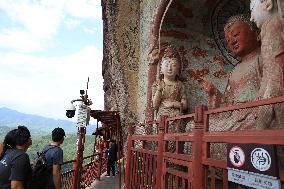
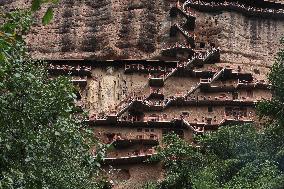
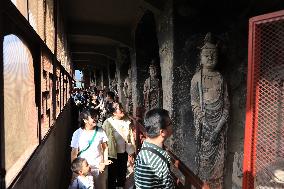
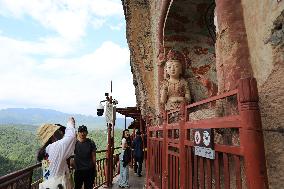
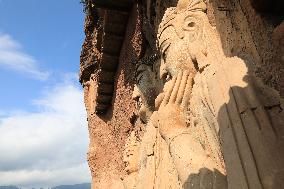
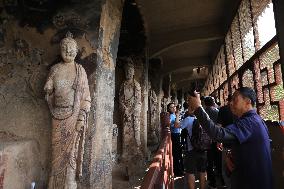
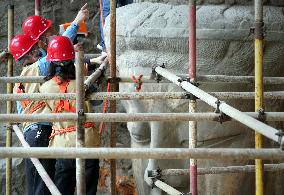
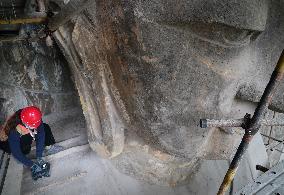
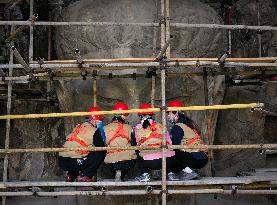
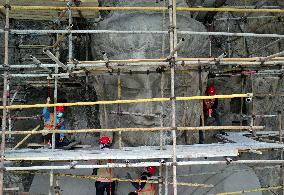
TIANSHUI, CHINA - SEPTEMBER 16, 2024 - Tourists visit a cave Buddha statue at the Maiji Mountain Grottoes, a world cultural heritage site, in Tianshui city, Northwest China's Gansu province, Sept 16, 2024.

  •  
Maiji Mountain Grottoes Cave Buddha Statue

Maiji Mountain Grottoes Cave Buddha Statue

TIANSHUI, CHINA - SEPTEMBER 16, 2024 - Tourists visit a cave Buddha statue at the Maiji Mountain Grottoes, a world cultural heritage site, in Tianshui city, Northwest China's Gansu province, Sept 16, 2024.

  •  
Maiji Mountain Grottoes Cave Buddha Statue

Maiji Mountain Grottoes Cave Buddha Statue

TIANSHUI, CHINA - SEPTEMBER 16, 2024 - Tourists visit a cave Buddha statue at the Maiji Mountain Grottoes, a world cultural heritage site, in Tianshui city, Northwest China's Gansu province, Sept 16, 2024.

  •  
Maiji Mountain Grottoes Cave Buddha Statue

Maiji Mountain Grottoes Cave Buddha Statue

TIANSHUI, CHINA - SEPTEMBER 16, 2024 - Tourists visit a cave Buddha statue at the Maiji Mountain Grottoes, a world cultural heritage site, in Tianshui city, Northwest China's Gansu province, Sept 16, 2024.

  •  
Maiji Mountain Grottoes Cave Buddha Statue

Maiji Mountain Grottoes Cave Buddha Statue

TIANSHUI, CHINA - SEPTEMBER 16, 2024 - Tourists visit a cave Buddha statue at the Maiji Mountain Grottoes, a world cultural heritage site, in Tianshui city, Northwest China's Gansu province, Sept 16, 2024.

  •  
Maiji Mountain Grottoes Cave Buddha Statue

Maiji Mountain Grottoes Cave Buddha Statue

TIANSHUI, CHINA - SEPTEMBER 16, 2024 - Tourists visit a cave Buddha statue at the Maiji Mountain Grottoes, a world cultural heritage site, in Tianshui city, Northwest China's Gansu province, Sept 16, 2024.

  •  
Maiji Mountain Grottoes Cave Buddha Statue

Maiji Mountain Grottoes Cave Buddha Statue

TIANSHUI, CHINA - SEPTEMBER 16, 2024 - Tourists visit a cave Buddha statue at the Maiji Mountain Grottoes, a world cultural heritage site, in Tianshui city, Northwest China's Gansu province, Sept 16, 2024.

  •  
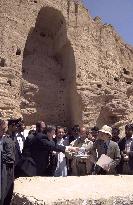
Japan provides funds to preserve Bamyan remains

Japan provides funds to preserve Bamyan remains

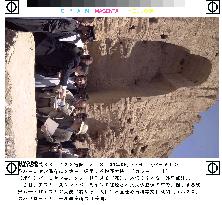
BAMYAN, Afghanistan - Japanese Ambassador to Afghanistan Kinichi Komano (2nd from R) shakes hands with Martin Hadlow, head of UNESCO's Kabul office, in Bamyan, central Afghanistan on June 2 after signing a document on 210 million yen in funds Japan will provide for preserving the Bamyan remains. At the background is a cave where there was a huge statue of Buddha which was demolished by the Taliban.

  •  

Gold, colored glass found on Buddhist statues in Longmen Grottoes

STORY: Gold, colored glass found on Buddhist statues in Longmen Grottoes DATELINE: June 2, 2022 LENGTH: 00:01:18 LOCATION: ZHENGZHOU, China CATEGORY: CULTURE SHOTLIST: 1. various of the Buddhist statues at the Longmen Grottoes STORYLINE: Archaeologists have found gold and silver elements and colored glass on Buddhist statues at the Longmen Grottoes, a UNESCO World Heritage site, in central China's Henan Province. The findings, among other scientific and archaeological achievements, have been made since a reinforcement and protection project of the Fengxiansi Cave of Longmen Grottoes was launched in December 2021, said the Longmen Grottoes research institute. Based on advanced technologies, archaeologists found gold and silver elements on the face of Vairocana Buddha, a giant statue that was built in the Tang Dynasty (618-907). "It suggests that skills such as gilding had probably been used in the construction of the Vairocana Buddha," said Shi Jiazhen, president of the institute. On the body surface of

  •  
CHINA-HENAN-LONGMEN GROTTOES-BUDDHIST STATUES-FINDINGS (CN)

CHINA-HENAN-LONGMEN GROTTOES-BUDDHIST STATUES-FINDINGS (CN)

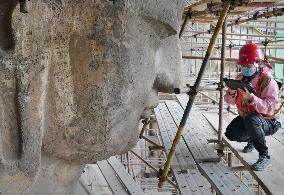
(220531) -- ZHENGZHOU, May 31, 2022 (Xinhua) -- Undated file photo shows an archaeologist examining the face of a Buddha statue at the Fengxiansi Cave of Longmen Grottoes in central China's Henan Province. TO GO WITH "Gold, colored glass found on Buddhist statues in Longmen Grottoes" (Longmen Grottoes Research Institute/Handout via Xinhua)

  •  
CHINA-SHANXI-DATONG-YUNGANG GROTTOES-RELICS RESTORATION (CN)

CHINA-SHANXI-DATONG-YUNGANG GROTTOES-RELICS RESTORATION (CN)

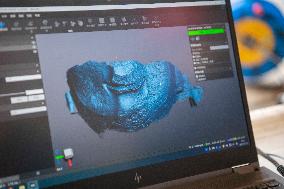
(220512) -- DATONG, May 12, 2022 (Xinhua) -- A three-dimensional image of a Buddha statue in Cave 17 of the Yungang Grottoes is seen on a screen in Datong, north China's Shanxi Province, May 11, 2022. A group of technicians of the Yungang Research Institute are striving to create digital versions of Cave 17 of the Yungang Grottoes in Datong, north China's Shanxi Province. The institute is dedicated to protection, research and management of the Yungang Grottoes. In recent years, working staff of the institute have been engaged in collecting and digitalizing information of the grottoes relics for the purpose of facilitating digital archives of them. The digitalization of the information is meant to explore new feasible methods of researching on the relics and to keep them in reliable and lasting protection. The Yungang Grottoes, with 45 major caves and more than 59,000 statues, were inscribed on the UNESCO World Heritage List in 2001. To date, one-third of the overall information collection and

  •  
CHINA-HENAN-LUOYANG-LONGMEN GROTTOES-RESTORATION (CN)

CHINA-HENAN-LUOYANG-LONGMEN GROTTOES-RESTORATION (CN)

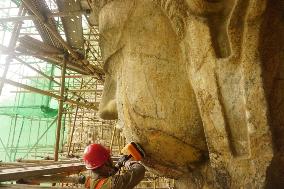
(220416) -- LUOYANG, April 16, 2022 (Xinhua) -- A staff member surveys a Buddha statue at the Fengxian Temple of Longmen Grottoes during a restoration project in Luoyang, central China's Henan Province, April 14, 2022. A restoration project is now underway at the Fengxian Temple, the largest cave of Longmen Grottoes. Water seepage and perilous rock bases are the two factors that threaten the existence of cultural relics in the grottoes. New technologies have been adopted in the restoration, such as ground penetrating radar detection and protective nets design. This has been the first large-scale restoration project of the temple since 1970s. The restoration started in December 2021 and has so far completed about 70 percent. The whole project is expected to finish in June this year. (Xinhua/Li An)

  •  
CHINA-HENAN-LUOYANG-LONGMEN GROTTOES-RESTORATION (CN)

CHINA-HENAN-LUOYANG-LONGMEN GROTTOES-RESTORATION (CN)

(220416) -- LUOYANG, April 16, 2022 (Xinhua) -- Staff members examine a Buddha statue at the Fengxian Temple of Longmen Grottoes during a restoration project in Luoyang, central China's Henan Province, April 14, 2022. A restoration project is now underway at the Fengxian Temple, the largest cave of Longmen Grottoes. Water seepage and perilous rock bases are the two factors that threaten the existence of cultural relics in the grottoes. New technologies have been adopted in the restoration, such as ground penetrating radar detection and protective nets design. This has been the first large-scale restoration project of the temple since 1970s. The restoration started in December 2021 and has so far completed about 70 percent. The whole project is expected to finish in June this year. (Xinhua/Li An)

  •  
CHINA-HENAN-LUOYANG-LONGMEN GROTTOES-RESTORATION (CN)

CHINA-HENAN-LUOYANG-LONGMEN GROTTOES-RESTORATION (CN)

(220416) -- LUOYANG, April 16, 2022 (Xinhua) -- Staff members examine a Buddha statue at the Fengxian Temple of Longmen Grottoes during a restoration project in Luoyang, central China's Henan Province, April 14, 2022. A restoration project is now underway at the Fengxian Temple, the largest cave of Longmen Grottoes. Water seepage and perilous rock bases are the two factors that threaten the existence of cultural relics in the grottoes. New technologies have been adopted in the restoration, such as ground penetrating radar detection and protective nets design. This has been the first large-scale restoration project of the temple since 1970s. The restoration started in December 2021 and has so far completed about 70 percent. The whole project is expected to finish in June this year. (Xinhua/Li An)

  •  
CHINA-HENAN-LUOYANG-LONGMEN GROTTOES-RESTORATION (CN)

CHINA-HENAN-LUOYANG-LONGMEN GROTTOES-RESTORATION (CN)

(220416) -- LUOYANG, April 16, 2022 (Xinhua) -- A staff member surveys a Buddha statue at the Fengxian Temple of Longmen Grottoes during a restoration project in Luoyang, central China's Henan Province, April 14, 2022. A restoration project is now underway at the Fengxian Temple, the largest cave of Longmen Grottoes. Water seepage and perilous rock bases are the two factors that threaten the existence of cultural relics in the grottoes. New technologies have been adopted in the restoration, such as ground penetrating radar detection and protective nets design. This has been the first large-scale restoration project of the temple since 1970s. The restoration started in December 2021 and has so far completed about 70 percent. The whole project is expected to finish in June this year. (Xinhua/Li An)

  •  
CHINA-HENAN-LUOYANG-LONGMEN GROTTOES-RESTORATION (CN)

CHINA-HENAN-LUOYANG-LONGMEN GROTTOES-RESTORATION (CN)

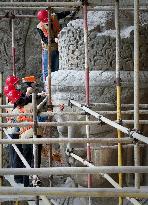
(220416) -- LUOYANG, April 16, 2022 (Xinhua) -- Aerial photo taken on April 13, 2022 shows staff members examining a Buddha statue at the Fengxian Temple of Longmen Grottoes during a restoration project in Luoyang, central China's Henan Province. A restoration project is now underway at the Fengxian Temple, the largest cave of Longmen Grottoes. Water seepage and perilous rock bases are the two factors that threaten the existence of cultural relics in the grottoes. New technologies have been adopted in the restoration, such as ground penetrating radar detection and protective nets design. This has been the first large-scale restoration project of the temple since 1970s. The restoration started in December 2021 and has so far completed about 70 percent. The whole project is expected to finish in June this year. (Xinhua/Li An)

  •  
CHINA-HENAN-LUOYANG-LONGMEN GROTTOES-RESTORATION (CN)

CHINA-HENAN-LUOYANG-LONGMEN GROTTOES-RESTORATION (CN)

(220416) -- LUOYANG, April 16, 2022 (Xinhua) -- Aerial photo taken on April 14, 2022 shows staff members examining a Buddha statue at the Fengxian Temple of Longmen Grottoes during a restoration project in Luoyang, central China's Henan Province. A restoration project is now underway at the Fengxian Temple, the largest cave of Longmen Grottoes. Water seepage and perilous rock bases are the two factors that threaten the existence of cultural relics in the grottoes. New technologies have been adopted in the restoration, such as ground penetrating radar detection and protective nets design. This has been the first large-scale restoration project of the temple since 1970s. The restoration started in December 2021 and has so far completed about 70 percent. The whole project is expected to finish in June this year. (Xinhua/Li An)

  •  
Japan provides funds to preserve Bamyan remains

Japan provides funds to preserve Bamyan remains

BAMYAN, Afghanistan - Japanese Ambassador to Afghanistan Kinichi Komano (2nd from R) shakes hands with Martin Hadlow, head of UNESCO's Kabul office, in Bamyan, central Afghanistan on June 2 after signing a document on 210 million yen in funds Japan will provide for preserving the Bamyan remains. At the background is a cave where there was a huge statue of Buddha which was demolished by the Taliban. (Kyodo)

  •  
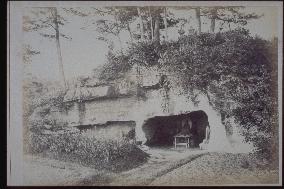
Statue of buddha in a cave

Statue of buddha in a cave

This same photograph was carried on page 154 of the December 1, 1871 edition of The Far East. On the outer part of the photo is written, AMISH'KI THE GOD IN THE CAVE . It is a statue of Buddha in a cave, AMISH'KI is Amiisshiki Village in Odawara City, Kanagawa Prefecture. A stone tower stands on the hill where the cave is located. The small hill as a whole is a spiritual zone.==Date:unknown, Place:Odawara, Photo:unknown, (Credit:Nagasaki University Library/Kyodo News Images) [Cabinet Number24‐22‐0]

  •  
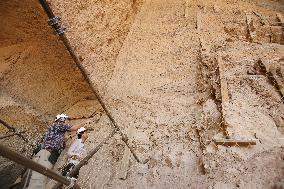
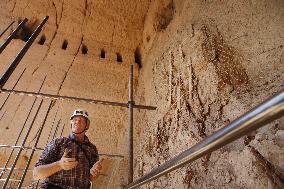
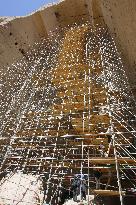
Reinforcement work at Bamiyan Cave

Reinforcement work at Bamiyan Cave

Reinforcement work is under way on Sept. 18, 2017, at Bamiyan Cave in Afghanistan, where a 55-meter-high statue of Buddha was destroyed by Taliban militants in 2001. The work, supported by the Japanese government, is expected to be completed in 2020. (Kyodo) ==Kyodo

  •  
Reinforcement work at Bamiyan Cave

Reinforcement work at Bamiyan Cave

Reinforcement work is under way on Sept. 18, 2017, at Bamiyan Cave in Afghanistan, where a 55-meter-high statue of Buddha was destroyed by Taliban militants in 2001. The work, supported by the Japanese government, is expected to be completed in 2020. (Kyodo) ==Kyodo

  •  
Reinforcement work at Bamiyan Cave

Reinforcement work at Bamiyan Cave

Reinforcement work is under way on Sept. 18, 2017, at Bamiyan Cave in Afghanistan, where a 55-meter-high statue of Buddha was destroyed by Taliban militants in 2001. The work, supported by the Japanese government, is expected to be completed in 2020. (Kyodo) ==Kyodo

  • Main
  • Top
  • Editorial
  • Creative
  • About Us
  • About ILG
  • Terms of use
  • Company
  • BEHIND
  • Price List
  • Single Plan
  • Monthly Plan
  • Services
  • Shooting
  • Rights Clearance
  • Support
  • FAQ
  • How To Buy
  • Contact Us
  • Become a Partner

© KYODO NEWS IMAGES INC

All Rights Reserved.

  • Editorial
  • Olympics
  • News
  • Sports
  • Japan
  • Tech
  • Royal
  • Disaster
  • NorthKorea
  • Old Japan
  • SNS
  • Creative
  • Food
  • Japan
  • Landscape
  • Animal
  • Popular
  • #Ukraine
  • #Thailand
  • #coronavirus
  • #N. Korea
  • #China
  • #Russia
  • #Ukraine
  • #Thailand
  • #coronavirus
  • #N. Korea
  • #China
  • #Russia
  • Food
  • Japan
  • Landscape
  • Animal
  • Olympics
  • News
  • Sports
  • Japan
  • Tech
  • Royal
  • Disaster
  • NorthKorea
  • Old Japan
  • SNS